Sunday, October 26, 2014

Too many shawls

A couple of weeks ago I finally folded and put away the shawls that have been lying on my ironing board. It necessitated emptying a bottom drawer in my dresser, getting rid of things that have accumulated there over time, folding and putting the various wraps and stoles I possess neatly away. The drawer is full. There are shawls I have knitted, a shawl I crocheted, two near-identical white lace shawls (one I bought, one my mother-in-law gave me), silk wraps I purchased from Burmese fundraisers, pashminas bought at the Montreal bus station and two gorgeous stoles bought in New York from the Metropolitan Museum on separate occasions (one painted silk, one a pashmina). There is even a black satin stole from a Montreal airport store. I have probably missed a few. The point is, I have way too many shawls. I can’t wear them all, and yet I keep knitting them. The most recently completed FO of this genre was undertaken for a MKAL on Ravelry: Rapt for the Holidays (Holiday MKAL 2014) by Heather Anderson.

I’ve been trying to figure out what the appeal of MKALs is. I haven’t yet, so that’ll be a discussion for a future time. In the meanwhile, I should talk about the shawl that is now in a zip-lock plastic bag awaiting a decision on its fate. I had bought a skein of Marine Silk-Lace from Blue Moon Fiber Arts at the Toronto Knitters Frolic last spring which was the right weight (lace and 100 gm) for the undertaking. I went to a local jewelry supply store and purchased way too many beads. I was prepared!


Heather leaked the clues one chart at a time. First the beginning of a semi-circle following Elizabeth Zimmerman’s π formula in stockinette; then a chart of snowflakes, then a chart of lace candy canes. Aware that not everyone would want to make a garment too obviously reminiscent of Christmas, she included an alternate second chart which more people chose to knit, even though it was untested. I am included in that group. Then there was another chart of snowflakes, followed by a chart of wreaths, a final sprinkling of snowflakes, and a row of fir trees. People posted photos of their FOs before I was even close to the last bit, and I determined that the trees looked a little squat; so I added another set of branches. There was a beaded eyelet edging, and a choice of blocking it with points or not. I chose points. Here is my FO with the pins.


After I photographed it, I repinned the edge to redistribute the points. I’m much happier with the finished result.


Now. What do I do with it?

Monday, October 20, 2014

When love hurts.

I love to knit. You who read this probably love to knit. Why else would you read a knitting blog? But sometimes the things we love most can be bad for us. They say that if you are suffering from gastric distress or an allergic reaction or something along those lines to look to your favourite food for the culprit. This is so often the case. My brother was diagnosed with lactose intolerance. Milk was his favourite food. My daughter loves eggplant but some day it might actually kill her. Some people who love bread and other bakery products end up being diagnosed with celiac disease or wheat allergies. They have to make dietary sacrifices to maintain their good health.

I have no such issues. Well, not exactly true that, since I am also, like my daughter, allergic to eggplant. However, unlike her, I despise it, so avoiding it is not an issue. What I do like to do is knit, and presently I am experiencing pain in my left elbow which I have self-diagnosed as tendonitis caused by indulging in my preferred activity. I have one project in particular to blame for this condition, a shawl I volunteered to test knit.

I saw the call for knitters in The Testing Pool on Ravelry and liked the photograph of the designer’s FO. It’s a crescent shawl, extremely lacy with beads strategically placed, and I was sucked in like a paper boat in a whirlpool. I soon found out that one of my knitting buddies had also signed up for the test, so we had a lot of notes to compare as we went along. The designer had left the pattern extremely open ended, allowing for lace right from the get-go, or for varying depths of stockinette stitch before embarking on the lace. There was also no stipulation for the number of repeats of the charted pattern; again that was left up to preference. The lace edging was easy to lengthen as desired, being only two rows that repeated until one felt it was time to bind off. I’m much happier with specific directions, especially in a test knit, but I embarked willingly enough on this project. For yarn I cast on with Manos del Uruguay lace in a lovely variegated blue and used No. 8 clear beads with silver centres.

It did not take me long to find issues with the pattern. There were the usual typos one discovers, but my main problems were with the lace charts and I took some issue with the designer because she was not only slow to understand my notes, but also defensive. As I may have mentioned in this blog at some other time, patterns are all about the completed FO. The instructions must be clear and easy enough for the stupidest of people to understand. The best patterns are ones which tell you exactly what to do without a lot of written-out explanations. We don’t want to read; we want to knit!

If I may digress for a moment, those same directions were given to me when I was learning choral conducting. The conductor must know the music well and be able to relay to the choir (or orchestra or band) what he wants through hand gestures only. If he has to explain it, then you know that he’s not a very good conductor. The musicians/singers don’t need to know any of the philosophy or background of the piece; they just need to have a good  director directing them and a well-written score. The choir/orchestra/band has often been compared to the conductor’s instrument, in the same way that the violin is an instrument. You don’t tell your violin what you want it to do; you just play it. The same thing stands for the conductor. He must play his instrument and do it without it being concerned about anything but what he has them do.

So, back to the knitting: I cast on, knit the 36 or so rows required for the depth of stockinette I was aiming for, then started the lace chart. The designer had provided both charts and directions. The latter were clearly written and laid out in the order of tasks performed. The charts were another story. There were four of them: a) the optional stockinette section; b) main lace repeats; c) transition lace section; and d) edging. The first problem was super evident: she had placed them on the page with the first chart at the bottom and the last chart at the top so that they lined up top of one to bottom of next. Even as I type this I am still amazed at the stupidity of this arrangement. As I told the designer, we read patterns from the top of the page down; especially if we are using a computer or tablet where we must scroll to the next page. If you turn the page and start looking for Chart 1 and instead see Chart 4 at the top, you are immediately confused. I explained to her that I understood her aesthetic reason for placing the charts as she had, but a pattern is not a work of art; the finished knitted garment is the ultimate goal. One must make sacrifices at times.

The next issue—which actually caused me some real grief—was the chart for the edging. She did not show the WS rows in it, but had illustrated three RS rows. Her brief description called it a two-row chart to be repeated ad libitum with a knitted bind-off on the WS. I saw three rows, the first one labelled with a 1, and the others left unnumbered. The first row showed the edge increases, the other two did not. So I knit my first RS row according to the chart, then knit the identical thing for the WS without the edge increases. When I got to the end I thought to myself, “This looks terrible,” and read her written instructions for the edging. They made perfect sense. The chart was horribly wrong. I had to tink that entire row, and then purl a proper WS (with edge increases) before I could continue. When I brought this up to the designer, she simply couldn’t comprehend what was not to understand. She even asked me if the chart was understandable once I read the instructions, and I said, no, the instructions pointed out how glaringly wrong the chart was. My friend got in the act and helped me out, but it took a lot of correspondence in the thread before she realized that she should remove the two bad rows from the chart and reword the label.

The final problem was the knitted bind-off. I used a 8-mm needle for it and it was still too tight to block out points in the finished shawl. The designer should have specified a Russian or other lace bind-off. Since it was a test, I completed it as instructed. If it had not been a test, I would definitely have used a different bind-off.

Nonetheless, the FO is very pretty. I was not all that keen on her method of shaping the lace, but it was still effective and I like the beads. Here it is draped over the armchair in my living room:


I got one of my knitting group ladies to model it (and another to photograph it with her phone since I’d forgotten my camera) and it looks so nice on her, that I think I will gift it to her this upcoming holiday season.


I will never test for this designer again. It simply wasn’t fun and I believe I was tense the whole time, thus causing my elbow to develop tendonitis. But I’m still knitting. There will be more updates on FOs shortly.

Tuesday, September 16, 2014

The knitted-lace chart dilemma: To be symmetrical or to list to port?

I have just finished test knitting a shawl by the exquisite Mary-Anne Mace. This is the second garment I have had the honour to test for her, the first being the nuppy Minarets and Lace shawl which shows up in another post here. In my view, she is a wonderful designer. I love her creations. Even before I discovered her on Raverly, I fell in love with Regenerate, a triangular shawl she conceived of while watching the renewal of nature following the terrible devastation of the September, 2010 earthquakes in New Zealand. When I saw she had another shawl ready for test knitting, I quickly volunteered my services.

I’m afraid that as a test knitter, I’m a bit of a pain in the ass. I don’t stop at finding typos and errors in the pattern; I try to find easier ways to explain to other knitters how to get the desired results. It is my philosophy that a pattern should be made easy enough for even the stupidest person to follow. That doesn’t mean the knitter can be a beginner. There are often techniques (like nupps) that require a fair bit of experience. It’s just that even an experienced knitter can become confused when instructions are not perfectly clear, or when an abbreviation is not explained fully or is similar to something else or simply doesn’t seem to make intuitive sense. I bring these things up and try to clarify them so that the knitting experience is as stress free as possible.

Having said all that, I now move on to the “meat” of the matter: the lace chart. When I learned to knit, there were no lace charts in knitting patterns; at least, not in the patterns I learned from. Most of the knitting books I still have from that era have every line written out in full, with asterisks setting off repeated parts. They are very wordy. Because the type is often quite small (needing to accommodate all those words and abbreviations), they are also hard on the eyes and it is easy to jump from one line to another and make mistakes. Until the pattern is established, you also have no idea what your lace will look like. Lace charts are a much, much better innovation. I am mystified as to why it took so long for publishers to include them in knitting patterns, since designers must have used charts to plan out their lace in the first place. However, that was then and this is now.

Now we have beautiful, detailed charts showing the directions of k2tog and ssk stitches, Os for yos, plain for knit, dotted or dashed for purl. It is the difference between a well-drawn road map with landmarks and a sheet of written instructions telling you to drive 12 km, then turn right at County Road 14. I would prefer to have the map so I can see where I’m going.

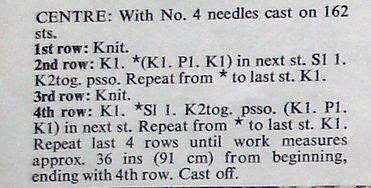
When one of my colleagues was pregnant with her first child, I made a baby blanket from a rather ancient book (about which I have already spoken in this blog). It consisted of a square in the middle, surrounded by an edging of four strips with mitred corners sewn on after. The instructions took two whole pages and buckets of words, words, words. Thus:


The central part consisted of a stitch pattern which drove me crazy until I had ripped out several times.


It shouldn’t have been difficult. But it was. After I finally got the hang of it, it turned out great.


It was, however, the lace edging which turned out to be extremely challenging. After all, there are a page and-a-half of closely-typed instructions. I ended up drawing myself a chart so I could see what I was doing. It was just pencil on graph paper, but it sufficed. This is what I was charting.


What I noticed as I drew my chart, is that the repeats for the pattern do not occur at the same place on every line. For example:

Row 5: p2tog, p2, k2tog, yo, p2, *k1, yo, k5, yo, k2tog, p1, ssk, p1, k2tog, p1, ssk, yo, k5, yo, k1, p2, k2tog, yo, p2. Repeat from * 5 times, p2 tog.
Row 6: purl the purls and knit the knits (it doesn’t say that, but that’s basically what it is)
Row 7: p2tog, p1, *yo, ssk, p2, k1, yo, k7, yo, ssk, p1, ssk, yo, k7, yo, k1, p2. Repeat from * 5 times. yo, ssk, p1, p2tog.

So, just from those three lines above, if you were to draw a chart, you would see that Row 5 begins its pattern repeat after the seventh stitch; Row 7 begins after the second. That makes sense when you are reading each line without regard to the “big” picture, but if you were charting it, you would draw a red box around the section to be repeated, with the different bits (in this case, the mitring edges) on either side. In the case where the WS is all purled, it would even make sense to start your box at the very beginning of your motif that repeats. But the wrong side of this fabric is not mindlessly purled. It is written out, too. Here’s the row I glossed over:

Row 6: k3, p2, k2, *p9, k1, (p1, k1) twice, p9, k2, p2, k2. Repeat from * 5 times, k1.

Remember, when charting that, you’re reading from left to right now, and of course all the purls and knits will be reversed so that the chart presents the RS only. Since the pattern is symmetrical, it makes sense to me to draw the red box around it so that when you read the chart from either direction, you’ll get the same number of stitches to the centre of the motif. So, for that line of instructions above, Row 6, I would have rewritten it thus: k3, p1, *p1, k2, p9, k1, (p1, k1) twice, p9, k2, p1. Repeat from * 5 times, p1, k3. (I actually had to draw it out on graph paper to see where I needed to put those asterisks.) That way you have a perfectly symmetrical motif.

Mary-Anne’s pattern was perfectly symmetrical. There was lace on both right and wrong sides of the fabric, which meant that, once you figured out which way to do the purling equivalents of k2togs and ssks on the WS, if you put your stitch markers smack dab in the middle of the no-man’s land between motifs, you had the same number of stitches to count on either side. That is exactly what I did. But that isn’t what Mary-Anne did. She had drawn  her box so that it began with the beginning of the motif on the RS. Under normal circumstances, this wouldn’t be an issue for me. But there was lace making going on on the WS of the fabric, which meant that when I read the chart from left to right, it was not the same as the right side number-of-stitches-wise. This was confusing because just looking at the chart, the symmetry was so evident! So I ignored her red box and did my own thing. But remember, this was a test knit. I was supposed to be doing what the designer instructed to see if it worked. In my opinion, it did not work. My method worked better. But she wanted to use her method because she was following this particular guide.

So in the end, I suppose we agreed to disagree. When I see a symmetrical chart, I will automatically start counting my repeat from the equal division between the two motifs, especially if the pattern is charted on both right and wrong sides. So there.

Saturday, August 30, 2014

Dreaming about dreaming in technicolour, or, Not this again!

About a month ago we hosted a reunion at our house of my husband’s undergrad roommates. This is a bunch of guys who lived together in one house for several years while they were students at what was then called the University of Western Ontario and has (for no reason I can fathom) been renamed Western University. Their first impromptu reunion occurred at our 25th wedding anniversary shindig seven years ago. They had such a good time that they decided to do it every year. It hasn’t actually been an annual thing, but close enough to be called regular. Sometimes it has involved everyone’s families; other times, just the guys themselves.

There is one exception to this: the oldest member of the group has remarried and his wife accompanies him to these gatherings. She was there last year when they congregated at Cape Cod (I was in Paris being a cultural tourist) and the year before in New York. I have managed to avoid them for the most part. I do not drink and that is what they mostly do when they get together, plus play guitar and generally whoop it up like a bunch of college students. Boys will be boys. The wife, however, is a gentler soul. She drinks, yes, but she doesn’t whoop. This summer she was recovering from knee (or was it hip?) surgery, so was also rather sedentary, although we did get her to come on a tour of a local abandoned copper mine cum museum and she was a very good sport about all the stairs and only had one breakdown when her claustrophobia got the best of her.


While the boys were playing guitar and drinking, she was doing needlepoint. This is not a craft I have ever taken an interest in; I embroidered my jean jacket when I was a teen as was then the fashion, and I think some pillow cases when I was first learning the art, but I feel that it is a purely decorative craft and I am much better in the construction of things, not their embellishment (although I do like knitting with beads, which is fodder for a future post). Jen was working on cushion covers for the planned reupholstery of their dining room chairs. She had completed one, which she had brought with her, and was in the process of finishing another. She is very slow and meticulous, working only when she has a spare moment, and produces about one a year.

Her canvases were preprinted with intricate abstract designs in many colours and were quite beautiful. No two were alike. She told me they were designs by Kaffe Fassett, a name I had come across when I was reading Adrienne Martini’s book, but hadn’t bothered investigating further. Jen and I looked him up on the internet and pored over all the photographs of his work and I was suitably impressed and amazed. His designs are intricate, colourful and captivating. For example, this one:

Here’s one that is a little more “traditional” looking:

But he doesn’t just design needlepoint cushion covers. His work can be found in rugs, fabric, mosaics and, of course, knitting. I had to look at the knitting patterns. Look at this, from his Peruvian collection:


and this:


I can only imagine that it was these images (and more) which induced that dream I had about knitting Fair Isle.

I recently pulled out a pattern book I bought in the 1980’s (pub. 1983) which I had purchased with an eye to making some of the garments within. Some of them are rather dated now, but others have held up well over time. The one on the cover indicates the era which spawned it.


A quick Ravelry search reveals that several knitters have actually made this garment. Here’s one I particularly like:


There aren’t a lot of patterns from The Sweater Book which have found their way into the Ravelry database, unfortunately, and I am beginning to think it is time to remedy that omission. Here are a few that particularly caught my eye with their timeless quality, especially the last one with its catchy name.

Glitter Bands

Night & Day

Fair Isle

Red Neck
Perhaps there is some double-stranded knitting in my future after all. But don’t bet on it. At least, not for a while.

Monday, August 11, 2014

Dreaming in techni-colour

It finally happened. During an afternoon nap not long ago I dreamt about knitting. It wasn’t just any knitting, and it wasn’t any project I’ve recently completed or on which I’m now working. No, I dreamt that I was doing stranded colour work, knitting a fair isle sweater with a complicated design à la Alice Starmore. I have no idea why as I really have no desire to make anything like that; unless, of course, my subconscious is trying to tell me something. I also dreamed recently that I had grown a full moustache and tuft of beard on my chin which, when combed and oiled, formed a beautiful van dyke and the kind of moustache that curls at the ends. This I can perhaps attribute to my lifelong desire to have facial hair that I could twirl à la Snidely Whiplash. But stranded colour work? I am not ready yet to remount that horse.

Yesterday afternoon I performed with my early music ensemble in a stone church built sometime in the early 1800’s. It was hot outside and in order to prevent traffic noises from disturbing our concert or the ceiling fans from playing with the acoustics, we played to a small, but appreciative, audience in sauna-like conditions. Apart from the crumhorns refusing to tune and play together nicely, it was actually a very good recital. But because of the heat, when I was not playing or singing, i.e. during solos performed by others of the group, my eyes closed and I sank into a bit of a torpor. I dreamt about knitting.


Wednesday, July 16, 2014

Lace

I love knitting lace. I’m not quite sure why. I mean, why should knitting lace fascinate me and keep me interested more than colour work, or cables? I have knit my share of Icelandic and Balkan sweaters in the past and they hold no interest for me now. But lace? Always.

My first foray into the world of lace knitting was a baby blanket I started in early 1985 pending the birth of a nephew who arrived in May. The blanket was not ready. Then it was earmarked for a niece who made her appearance at the end of November. It was still incomplete. In fact, I finished it about a month before my own daughter was born, a whole year after the first intended recipient’s birth. The good part was that I got to keep it.

I made it out of a cheap, baby-green acrylic yarn, the pattern from Beehive Book No. 405, a long out-of-print collection of shawls, both knitted and crocheted. Before I started knitting, I crocheted a shawl from the book which is quite lovely. It consists of a long line of scallops, joined successively by other scallops until it diminishes in size, forming a triangle. On a very long bus ride (Toronto to Sudbury ~5 hours) I parked myself next to an elderly woman (they make the best travelling companions) and crocheted the entire trip. At some point I realized that my “triangle” was getting wider, not narrower, and started to panic. My seat mate thought it was “just lovely” and was no help at all. It turned out I had not been joining the scallops of the previous row as I crocheted new scallops into them, and thus ended up ripping out a whole ball’s worth of yarn. However, I am digressing, as you no doubt have come to expect by now.

Here is my first lace baby blanket:


It’s still quite pretty, especially from a distance. However, the yarn, which used to be baby soft, has gotten kind of stiff and scratchy since 1985. Maybe a turn in the washer and dryer would soften it up again. Since it was my first lace project, it is not error free. At that time, I didn’t know how to correct my mistakes, so I just left them. Like this one:


and this one:


The edging was knitted separately and sewn on. I cannot imagine doing that now, but I do remember doing it then.


I did not knit lace again for many years. In fact, I believe my next lace project didn’t happen until 2009, when I was in Lettuce Knit in Toronto and picked up a skein of Lorna Laces Pearl, a silk-bamboo blend in DK weight in the most gorgeous pink-purple combination of colours. I couldn’t put it down. At all. In fact, I ended up paying $49.00 CAD for it, which is utterly preposterous. I wouldn’t pay that much for a skein of yarn again unless it was threaded with gold. Real gold.

What do you do with yarn that expensive? I couldn’t imagine making something for everyday wear, or that would need to be laundered repeatedly. It was just too precious. My daughter found a simple lace pattern for me on Ravelry which served to show off the sheen of the fibres in a decorative scarf which I wear as an accessory and not to keep warm.


It is lying, by the way, on a lacy bedspread my mother made for me as a wedding gift from worsted weight acrylic. Knitting runs in the family.

I had not yet caught the lace-knitting bug, though. That didn’t happen until the fall of that year when I needed a project for a ball of yarn I had bought in a shop in Picton, Ontario when my husband was composer-in-residence at their annual music festival. (It was also in this shop that I became acquainted with qiviut for the first time.) I fell in love with a ball of 100% merino (Jitterbug by Colinette), determined I would make socks from it. The helpful storekeeper advised me to get some reinforcing yarn for the heels and soles, which I did (Baby Kid Extra by Filatura Di Crosa, a blend of mohair and nylon).

I never did make socks with either yarn. The Jitterbug was too pretty for socks, and the Extra was too nice to hide away as a reinforcer for heels and soles. I embarked on my first Nightsongs shawl by Jane Araújo. It was torture. Sheer torture. At the time I made it, my mother was going through her extended decline into dementia and finally dying. It took a while. The stresses of my personal and professional lives combined with my mother’s illness to make me a total wreck. I remember sitting in front of the wood stove, the only warm place in the living room, staring at my knitting, wondering where I had gone wrong. According to my notes on Ravelry, it only took two weeks to make the scarf, but it felt like an eternity. The pattern required all of my concentration, which was a good thing as it kept me from thinking about what was really on my mind. Eventually I saw how the picture developed, the directions the k2togs took vs the ssks. Whereas I hadn’t really got it before, I did then.


As for the mohair-nylon blend? It became the scarf version of Anisette by Kristeen Griffin-Grimes from Canadian Living online. I later made the full-sized shawl from Shibui Knits Cloud Silk, but I needed to practise first.


Since then, of course, I have knit a lot of lace. I’ve also knit cables and other things with no adornment whatsoever. But it is the lace that keeps me interested in a piece. Always.

Tuesday, July 1, 2014

The City and the Stars

The title for this post comes from an Isaac Asimov story which has absolutely nothing to do with the subject under discussion, but could be the name of my most recent FO. Oh, wait, that’s exactly what I named it. Heather Anderson asked me if I would test knit her most recent shawl and I gladly responded in the affirmative. I had already knitted two of her shawls in KALs (knit alongs) and I found her instructions to be clear and straightforward. I also think she’s a talented designer, so I said, “Sure.”

The first shawl of Heather’s I made is semi-circular, with increase rows every now and again. I haven’t figured out the math, but instead of the shawl getting steadily bigger, as do triangular and crescent patterns, It merely is given the opportunity to stretch. That sounds weird. I’m not describing it very well. You start out with a garter tab and 12 stitches on your needle. After several rows, you quadruple the number of stitches on your needle, either by yarn overs, knitting front-back, or something else. Continuing on, knit the pattern, then double the number of stitches again. This increase happens one more time, and then you knit until you’re done. Bind off. Wet block. Wear.

Here is the first such shawl I made in this fashion:


It’s a pretty clever trick. That particular garment was knit in Classic Elite Yarns Silky Alpaca Lace on 4 mm. needles. The pattern called for fingering, but I’m really happy with the way it turned out. It’s even warm. However, this entry is not about that shawl.

The test knit I volunteered for is also a semi-circular shawl. Because it was a test, I used the weight of yarn and size of needles specified, but the rest was up to me. Heather’s name for it is City at Night. It’s whimsical, and she chose two shades of blue: dark and darker. I chose Knitpicks Stroll Glimmer in Kestrel and Black. The composition of the yarn is 70% Merino, 25% Nylon, 5% Metallic, the latter what the company calls “stellina”. It sparkles. The main body of the shawl has lace “stars” and the border has a ribbed representation of skyscrapers. In a fit of whimsy, I added a red shiny bead at the tip of each building to warn off low-flying planes. 


Here’s a closeup of the warning lights:


A friend’s response to my description of the buildings being in bas relief was, “If it is knitted out of lambswool, then they are in baa relief.” I wish I’d thought of that!

Finally, the finished garment warming me:


And that’s all I have to say about this one.