Thursday, August 30, 2018

Why the Yarn Chicken Crossed the Street

Remember a couple of posts ago I wrote about a shawl I’d played yarn chicken with and lost? It always irked me, that black cotton edge. I know it was very dramatic looking, but I didn’t like the way it hung, how the cotton didn’t have the same drape as the bamboo. So when I was at the Knitters Frolic in Toronto last April, I went in search of the Dye-Versions booth and sought out another skein of 100% bamboo fingering in Vampire’s Kiss. I found one, among other lovely things.


Then I unravelled the seven or eight rows from my shawl, got all those stitches put back on a circular needle, and proceeded to reknit (and rebead) the edging. I think it was worth it.


Wednesday, January 10, 2018

A Mashup and a KAL

I have been busily knitting away, so much so that I think I have injured my right elbow. But that isn’t enough to make me stop. No siree.

In December I completed another test knit for Mary-Anne Mace, my favourite NZ designer. She has created yet another absolutely gorgeous shawl, which she calls “Lace Eater Mashup” as she incorporates lace from various of her other designs to create something new. I made it out of two different yarns, Manos del Uruguay Lace (70% alpaca-25% silk-5% cashmere) and Estelle Yarns Baby Silk Lace (70% alpaca-30% silk). The story behind those two yarns is worth telling in itself.

An internet friend of mine was getting married, someone I had never met in the 3D world but whom I had come to know through an online RPG I subscribe to. We were clannies and I shall hereafter refer to her as Delmaya, that being the name I knew her by ingame. I wanted to do something for her and, after seeing a photo of her wedding dress, knew that she needed long gloves to cover her bare arms. I had already fallen in love with the Kensington Mitts pattern from the first Jane Austen Knits magazine, and she loved them too once I showed her the picture. So, now that a pattern had been chosen, I needed appropriate yarn.

That proved more difficult than I thought it would. On a visit to Toronto, and many many wool shops, I came away with fine lace, even though the pattern called for fingering. It meant that I ended up holding the yarn double, and the finished mitts turned out quite beautifully. However, let me tell you about my shopping expedition. At one point I found myself in the basement of Romni Wools on Queen Street. If a bargain is to be found, that is the place to find it. My gaze fell upon this skein of Estelle Yarns lace, marked down to $6.00. It was all by itself, not enough to do anything with on its own, and the colour was just not white enough for wedding mitts to be worn with a pure white gown. I dithered. I hemmed and I hawed. The old guy who haunts the basement of Romni Wools came around to give advice, which was, “It’s only $6.00; buy it!” So I did.

At EweKnit (in its old location in Mirvish Village), I engaged the help of the salesgirl, who scoured the store for something suitable. We could find nothing in a fingering weight yarn. It was pretty disappointing. Then she remembered that they had Manos del Uruguay Lace, which was absolutely perfect in every way except for the thickness. But, as I said, I could hold it double. So I bought two skeins. The colour wasn’t pure white, but a creamy white, warmer than the wedding dress, but sufficiently pale to match.

Because Delmaya lived at a distance from me and wasn’t around for actual fittings, I used the Estelle lace to make parts of the mitts in different sizes, which I mailed to her and had her try on, and then mail back with copious notes about fit. In this fashion, I was able to determine that she was a combination of sizes, and I could proceed accordingly. The mitts turned out beautifully. I was pleased, she was delighted, and the photographer captured them for immortality.


Aw.

Since I’d unravelled the Estelle lace from the test pieces and still had a quantity of the Manos left over, I decided to use these for the Lace Eater Mashup test knit. It meant separating the doubled strands, which took a fair bit of time and no small amount of frustration; but at last I had yarn to knit with. For the top of the shawl I used the leftover Manos, and for the rest the Estelle. I figured that the colours were similar enough that the change wouldn’t show, especially as it’s very lacy. I was right.


Nice, eh?

So, while you’re admiring the lace there, Mary-Anne is having a knitalong of this very shawl on Ravelry at this very moment. Feel free to join in. You won’t be sorry.

Wednesday, October 11, 2017

Playing yarn chicken... and losing.

While waiting for a computer ordered on ebay to arrive so I could get back to work at a project which would actually pay me real money, I embarked on what I called “nervous knitting” to keep me from losing my mind. It was a very stressful time. My own computer had overheated and died and I didn’t want to have to upgrade my software halfway through the project. I’ve been using the same program since 2006. So the Mac technician suggested I find a similar model to my own and he could transfer over the hard drive. I did as he suggested, purchasing an identical computer on ebay which took almost two weeks to arrive. It was during those two weeks that I knit another Mad Blood shawl by Mary-Anne Mace with 100% bamboo yarn by Dye-Versions I’d bought at last spring’s Knitters’ Frolic in Toronto. I’d also bought a large bag of No. 6 red beads, and as the yarn was a lurid combination of black and red called “Vampire’s Kiss,” I thought they deserved each other.


I tested this pattern years ago with a 100% wool light fingering yarn by Sweet Paprika and it made more of a shawlette than a shawl, especially as the wool tends to shrink up after blocking, not staying stretched out. Bamboo, though, is a different fibre altogether. It stretches hugely in the blocking and even afterward. In my original Mad Blood, I didn’t add beads. One of the testers did and the designer incorporated her placings into the final pattern. I decided there weren’t enough beads, and added more earlier on.


There was one issue that I considered and planned for, and that was that I didn’t have enough yarn to knit the pattern as written. So, accordingly, I eliminated one repeat of the vertical motif by omitting an increase row in the plain knitting part and starting the lace at the appropriate number of stitches. I still didn’t have enough of the bamboo.

I ran out of bamboo yarn nine rows from the end. This is not the first time I’ve gone stash diving to find something to edge a shawl with, and I think that contrasting edgings are often quite dramatic looking. But the problem was not a colour thing, but a textural issue. As I said, bamboo stretches. If I used wool, it would shrink up against the vegetable fibre. Silk might have worked, but I didn’t have any in my stash of an appropriate weight or colour. The best I could do was cotton fingering that I had acquired so long ago it seems like it’s always been there. It’s the stuff I pull out when I need a provisional crochet cast-on; not particularly high-quality material. But I used it anyway and this is the result.


It’s not great, but it works. My son took photos of me modeling it.


In retrospect, I probably should have worn a different top.

Saturday, July 1, 2017

Lysanne’s Fingerless Mitts

A couple of months ago I was in Montreal to attend a live show of the podcast “Welcome to Nightvale” and arranged to stay overnight with a friend whose acquaintance I had made in a rather roundabout way. Let us just say that an online MMORPG, an aged mother’s broken shoulder, and serendipity all played parts in bringing us together. We discovered a few more coincidences along the way, such as the boyfriend of the friend I had traveled with to Montreal being a good friend of hers as well. So, considering all that, I felt I could ask her to put me up that night as I didn’t feel like renting an expensive hotel room and didn’t know whom else to ask.

It was an absolutely delightful visit. Her cats were enthralled with my knitting, her husband made up a futon for me (so I didn’t have to sleep on the couch) and fed me an excessive breakfast the next morning. She took the day off work and we spent the morning exploring neat shops nearby, one of which is Espace Tricot on Monkland. I’d heard about this fabled yarn store, but this was my first visit. I found some nice skeins in the bargain bin and also bought a cake of Freia Ombré Fingering. My friend was also looking at sock yarn, although she doesn’t knit, and purchased a skein of Hedgehog Fibres Sock which she then handed to me and said, “Make me a pair of socks.” Well, I did that and had close to 40 gms leftover. So, I decided to make a pair of fingerless mitts to gift her as insurance against needing a place to stay in Montreal again. At first I tried to modify the pattern from the socks (Tea. Earl Gray. Hot), but it wasn’t working to my satisfaction. So I started over again and this is what I came up with.


I used a simple smocking stitch for the cuffs and knit two of them separately on dpns (because you have to switch stitches from one needle to another every other smocking round) before placing them both on one circular needle to continue. There are a left and a right with the thumb on each offset onto the palm of the hand, a very simple gusset, and more smocking for the fingers bindoff and an even simpler BO for the thumb; and there is a cable and lace panel for the back of the hand.

Not having charting software, I decided I would write up the pattern in a modular way, listing all the things I did and letting the knitter figure it out for herself. I also used 2.5 mm needles and a fine sock yarn, so these are definitely for a small hand. As the cuff is a multiple of four stitches, one could enlarge it by adding that many, and then having more stockinette on either side of the hand panel. I will leave all that up to the intelligence of the knitter and just give very basic instructions for the modules as I made them.

CUFF:

With size 2.5 mm dpns, CO 48 stitches. I used an Estonian long-tail cast-on because it goes better with k1p1 ribbing, which the smocking stitch basically is. Join in round (without twisting) and place marker for BOR.
Rds 1-3: k1p1 ribbing
Rd 4: *Insert RH needle between 3rd and 4th stitch on LH needle, pull yarn through, place loop on needle tip, then k2tog (new loop and first stitch of group of three), p, k, p.* Repeat to end of round.
Rds 5-7: k1p1 ribbing
Rd 8: k1,* p1, Insert RH needle between 3rd and 4th stitch on LH needle, pull yarn through, place loop on needle tip, then k2tog, p, k.* This includes the first stitch of the next round. Your BOR marker will remind you where you are and that you should put that last k stitch back on the LH needle.
Repeat these last 8 rds twice more, then repeat Rds 1-3 once more. This should give you a 2" cuff. If you are planning to make two mitts at once, knit an identical second cuff, and then place them both on a 2.5 mm circular needle so that you can continue with the hand.

I found it easier to knit the mitts with the palms up (i.e. they begin the round) so that I could coordinate my gussets more easily. As there are 48 stitches total, I began the RIGHT mitt with a purl and then started the gusset as follows:

Rd 1: after first purl stitch, place marker, m1, place marker, knit 23, begin back of hand panel (see below). As the purl stitch that starts the round is actually part of the back-of-hand panel, I will not repeat it in the instructions. You begin with the first SM.
Rd 2: slip markers, k to back of hand panel, continue in pattern.
Odd Rds 3-15: slip marker, m1R, k to marker, m1L, slip marker, k23, continue in pattern.
All even rds: slip markers, k to back of hand panel, continue in pattern.
At the end of Round 16, there should be 15 stitches between the SM. At this point, stop increasing and continue knitting straight until the hand is long enough for you to consider closing off for the thumb. When that happens (I had cabled 6 times on the back of the hand), put the stitches between the markers on waste yarn and join in the round, continuing until the hand is as long as you want it to be before the edge border.

LEFT mitt is very similar to the right. Remember that there is one purl stitch from the back of the hand pattern on the palm side.

Rd 1: k23, place marker, m1, place marker, p1 (and continue with of back-of-hand panel)
Rd 2: k23, k to 2nd marker, continue with pattern
Rd 3: k23, SM, m1R, k to marker, m1L, SM, continue with pattern
Repeat Rds 2 and 3 as per the Right mitt (i.e. until it’s long enough; this will be simpler if you’re making two at once) before putting the 15 thumb stitches on waste yarn.

(IN THE EVENT you don't want that misplaced purl stitch to worry about, you could arrange your stitches so you have 25 on the back of hand needle and make your thumb gusset right at the edge of the second needle [provided you are using a circular needle and not dpns]. It’s your choice. Just remember that the hand panel is 25 stitches wide.)

HAND PANEL:

The back of the hand has a simple lace and cable pattern that I devised myself. It is too fussy to write out instructions for all of it together, as the cables and lace do not coordinate. There is also that purl stitch beginning or ending the panel which is either on the end of the last needle or the beginning of the next, depending on which hand you are knitting. So I shall write instructions for the first few rounds and let the intelligent knitter figure out the rest. (C4L and C4R are 4-stitch cables, where the 2 right stitches cross in front of the left in the first instance, and then cross behind in the second. It doesn’t really matter which ones you do where, just as long as they are symmetrical.) (CDD is a central-double-decrease: slip 2 together knitwise, k, psso)

Rd 1: p2, C4L, p2, ktbl, yo, ssk, yo, cdd, yo, k2tog, yo, ktbl, p2, C4R, p2
Rd 2: p2, k4, p2, ktbl, k7, ktbl, p2, k4, p2
Rd 3: p2, k4, p2, ktbl, k2tog, yo, k3, yo, ssk, ktbl, p2, k4, p2
Rd 4: p2, k4, p2, ktbl, k7, ktbl, p2, k4, p2
Rd 5: p2, k4, p2, ktbl, yo, ssk, yo, cdd, yo, k2tog, yo, ktbl, p2, k4, p2
Rd 6: p2, C4L, p2, ktbl, k7,  ktbl, p2, C4R, p2
Rd 7: p2, k4, p2, ktbl, k2tog, yo, k3, yo, ssk, ktbl, p2, k4, p2
Rd 8: p2, k4, p2, ktbl, k7, ktbl, p2, k4, p2

By now you get the idea what’s going on. The 4-stitch cables are running along the sides, twisting in opposite directions every fifth round. The 7-stitch lace panel alternates with plain knits separating the rounds with the yos.

EDGE:

When the mitts are as long as you want them (mine are not that long as my friend works with computers and needs finger mobility), make a smocked edge starting with Round 4 of the cuff pattern. After 11 rounds, BO as follows: k1, p1, slip first stitch over second, yo, k1, slip first stitch plus yo loop over second. Continue in this fashion, binding off single purls and knits with their yo loops until the end. Pull up last loop, cut yarn, leaving tail to weave in.

THUMB:

Pick up thumb stitches from waste yarn and arrange somehow on your needle(s). Pick up and knit 3 stitches from the hand, closing the gap (18 sts), working 3 rounds of stockinette. Work one round of k1p1 ribbing. Bind off as for the hand.

Weave in ends, block, and presto! Beautiful fingerless mitts that only required a little bit of hair being torn out.

Thursday, June 22, 2017

Shawls and other things

I decided this year that I would cut back on the shawl knitting. I mean, come on, I have so many of them and I don't know what to do with them. But I do love knitting lace shawls, which is why I accepted the challenge of testing Mary-Anne Mace’s High Country Circle. She called for a DK or sport-weight yarn as her vision for this lovely thing was as a throw for a couch and a lap warmer for cold winter nights. I went to my LYS and was daunted by the cost of enough yarn for the whole project; but, happily, the owner had a pile of Sandnes Garn Tove she was trying to get rid of and made me a very good price. I found the wool a bit scratchy to work with, and it didn’t soften up that much in the subsequent washing and blocking, but it did make a lovely small blanket, which now adorns the couch in my living room.


The colours are kind of dull in that photo. Here’s another picture:


It only took me two months to make, which is pretty good considering I didn’t work at it every day.

I also made another of Mary-Anne’s shawls, The Emperor and the Scarab, from some silk-linen yarn I had got in a subscription box with beads. I had made one of these before from Patons Lace, which I was not happy with. It is now hanging in my friend’s LYS as an advertisement for that yarn. This time I used Grazioso by Sweet Paprika and was very happy with the result.


I also made a necklace with the beads and leftover yarn and gave them both to my sister-in-law for her 60th birthday.


There is one more shawl, another test knit, this time for Heather Anderson. I had received another subscription box including a pattern which again I disliked, but the yarn was perfect for Heather’s Hungry Caterpillar Shawl, so I used it. I was not too happy with the end result, as I had wanted the cool colours in the subscription and been sent the warm ones by error. But one of the ladies in the knitting group absolutely fell in love with the shawl and even offered to buy it from me. I could not refuse her.


I have made other things that weren’t shawls. I finally finished a pair of fingerless mitts I started last November, Jane’s Barathea Mitts from Jane Austen Knits 2014. I still had a large quantity (and still have 30 gms left over) of Rhapsody Light by Artyarns, the stuff that turns my hands green, so I used that and I'm very happy with the result.


I also finished a test knit in a similar colour but totally different yarns, also leftovers, for Sabine Kastner (not yet published).


The yarn for the main body is Qiviut Queen from Cottage Craft Angora and the contrasting cuff edging and hand flap Silver by Dye-Version. I like that they are only subtly different and that the silver has that discrete sparkle to it.

This post would not be complete without mention of my latest Biarritz Cloche. I love how this hat turned out. The one I’d made several years ago was from Patons Grace, a very nice mercerized cotton fingering weight yarn, but this time I used Drops Muskat, a slightly heavier weight of cotton. It’s labeled DK, but seems a bit sportier than that. Nonetheless, the resulting hat is fantastic. I don’t need any starch for it to keep its shape, and I get untold compliments on it.


Not the best photo. Here’s one my daughter took with her cellphone at my son’s recent convocation:


Thursday, March 9, 2017

A Baker’s Dozen

I finished 13 shawls last year—not quite the 15 of the year before, but enough that I’ve decided this has to stop, or at least slow down. I have so many, I don’t know what to do with them. My friends suggest I should sell them, but that just seems so mercenary to me. Yet, that is something I might do.

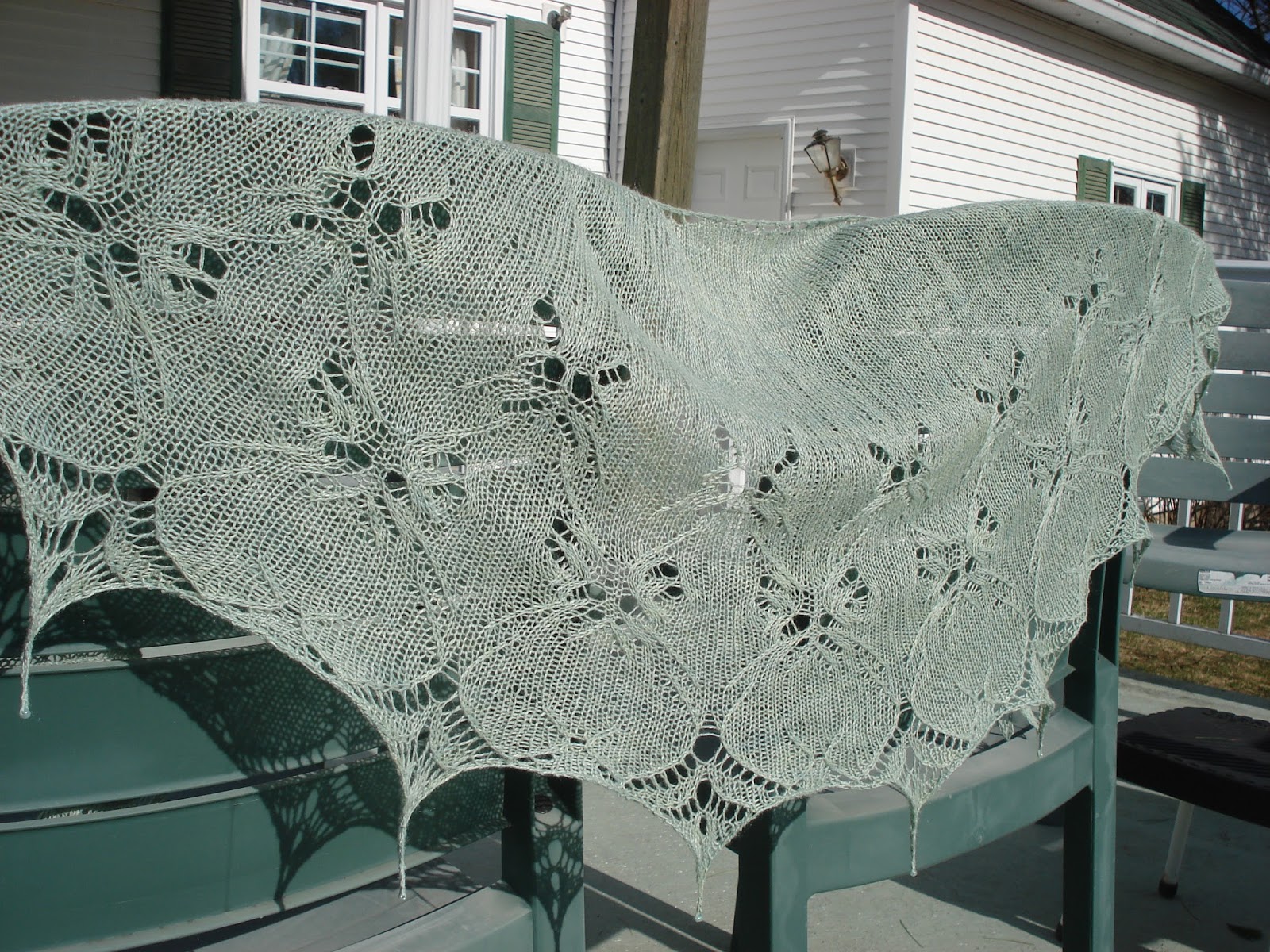
Anyway, after my last post, which was so very long ago I am terribly ashamed, I test knit another beautiful shawl for Mary-Anne Mace, Spring Creek. I used yarn I had bought at Rhinebeck which was originally earmarked for another project, two skeins of Hero by Bittersweet Woolery in complementary colourways: Midnight Heather and Sugared Lilacs, and sparkly silver-lined, transparent beads. The finished shawl was absolutely lovely and I named it Libellule for the dragonfly motifs around the edge. My only issue with it was that it itched when I put it over my bare shoulders. So I knew I would never wear this confection.


I started singing in a local United Church choir in the fall and decided to donate it to the Christmas bazaar silent auction table in the hopes that it would help raise some money. I shouldn’t have bothered. It ended up selling for $21 Canadian, about half what the yarn cost. I won’t be doing that again. Someone has a beautiful hand-made, designer lace shawl and has no idea what its value is.

My next FO, still on the purple theme, was Summer Sun Shawl by Heather Anderson from her Early in the Seasons eBook. I used Drops Brushed Alpaca Silk for it and beaded the slipped stitches that made up the “ribs”. While it came out looking very nice, I had forgotten that alpaca does not warm me the way wool does. It feels cool next to my skin, and it occurred to me that this shawl would not be something I would wear come winter. So I gave it to a friend who dropped by one afternoon, and she loves it.


Still sticking to purples, I test knit an asymmetrical shawl for Mary-Anne Mace, Half Empty, Half Full. I chose to use up some KnitPicks Diadem for the half-linen stitch section, and Madelintosh Tosh Merino Light for the lace. I am completely enchanted by the way it turned out, and called my version Something Wicked This Way Comes.


I even have enough of both yarns leftover to devise some sort of matching fingerless mitts. That’s for another project.

We still have two more shawls to go for 2016. The penultimate one was a test knit for Heather Anderson for The Friendly Giant Shawl from her new eBook, For the Love of Stories. It’s an interesting pattern that mimics the bubbles in BFG’s effervescent drink from the recent movie of that name. I made mine from Patons Classic as I wanted something warm for the winter. (That had been my intention with the other Anderson shawl I’d made, but you already know that story.) I made the smaller version, which contains one less repeat of the bubbles pattern. I don’t know where I went wrong, but I have one fewer cable patterns around the edge than the pattern called for. None of the other testers had this issue, so I must have missed something somewhere even though I counted and recounted and couldn’t find my error. Oh well. It’s still nice.


Finally, a last shawl for 2016, another test knit for Mary-Anne Mace, Tidal Zone, the name suggested by my description of a smooth beach leading to water-rippled sand. I didn’t call mine that, since I was inspired by the yarn I’d used to rename it Diamonds and Rust. My choices were Yummy Yarn Studio’s Merino/Nylon Superwash Sock 80/20 and some leftover KnitPicks Stroll Glimmer. They don’t show up well in the photo, but each picot on the edge has a red bead. I’m very pleased with the end result.


That was it for shawls. I did manage a few smaller projects, including a pair of fingerless mitts redesigned from lace cuffs in the Downton Abbey Unofficial Knits magazine. I had to figure out how to make a thumb opening and gusset from the top down, which was a challenge. I used the leftover Zed Luxe Sock by Yarn Indulgences from my Hellebore Clutch.


I also made three pairs of socks from Regia self-patterning yarn for different men in my life:


and one pair from Drops Fabel.


With that I wrapped up 2016. Phew!

Sunday, July 31, 2016

Playing catch-up

It has been months since I last posted any FOs here. I have been busy, not just knitting, but with life in general, so I am going to claim that as my excuse for being a bad blogger.

I have, of course, knitted more shawls since we last met and will tell you all about them shortly. But I also realized that I need to take a break from this production of wraps and stoles. I have no room for them in my drawers and not enough friends to give them to. Even though my acquaintances urge me to sell them, I can’t decide on what would be a fair price, taking into account materials (which can be quite pricey) and time (which is the truly valuable ingredient).


For instance, I test knit a gorgeous wedding shawl by Kristi Holaas which she first posted in the 12 Shawls Forever thread on Ravelry, looking for test knitters. I used a cobweb-fine yarn I bought at Rhinebeck last year, 55%/45% Silk & Angora by Skaska Designs, in an almost-white. I went down a needle size and cast on 485 stitches. The test, which was finished before I was, concluded about two months after it was posted. I didn’t bind off for almost two more weeks. Part of the problem was the sheer volume of knitting at the beginning: the rows went on forever! The yarn was superfine and if I made a mistake, was extremely hard to correct. Most of my errors actually happened when I had to tink back for something minor and dropped a stitch. Knitting up a dropped section set the tension on its head and I prayed that blocking would work its magic. As the shawl got narrower, the knitting got easier and I finally finished it, blocked it, and took pictures. The designer was delighted.


During this same period when I was test knitting Kristi’s shawl, I was also engaged in two other tests which I completed in the specified time frame. The first was for Heather Anderson, one of a quartet of shawls in her most recent series dedicated to early seasons. Hers is called First Snow Fall, but I called mine Pink Snow because of the colour of my yarn. I started out with the remaining 15th of a box of Kashmir Paint Box Gradient by Fiber Optic Yarns which I’d also picked up at Rhinebeck last fall, left over from yet another shawl for Heather which I’ll talk about soon. This lovely blend of merino (80%), nylon (10%) and cashmere (10%) made a nice soft neck edge, and then segued into the rest of the Sweet Georgia Tough Love Sock, also left over from the project I have not yet described. Unfortunately, I ran out just rows before the end, so finished it off with some dark purple Diadem by KnitPicks (50% alpaca - 50% silk) and was extremely pleased with the results. During the knitting I thought I would probably frog it after blocking and photographing, but it turned out to be such a beautiful FO that I changed my mind.


The other test knit that was going on at the same time was for Mary-Anne Mace, who recently got on the bandwagon and designed two asymmetrical shawls, this being the second. She calls hers Lacebark after a tree that grows in her native New Zealand. I call mine The More it Grows, the Lacier it Gets. For this one I chose a yarn I bought at this year’s Toronto Knitters’ Frolic, Sea Pearl by Briar Rose Fabrics, a blend of 50% merino - 50% tencel. The colour is not done justice in any of the photographs I took, unfortunately. It is an iridescent purple like the inside of a mollusc shell, or the surface of a black pearl. Sadly, all my photos came up with a steel gray. You’ll just have to take my word for it. Also, the dye came off rather badly on my hands as I knit and it took many washings and rinsings before I felt it was safe to block it. I’m concerned it will still bleed, but not as badly now. Here’s what my hands looked like while I was knitting it (and yes, I’m in my pjs and bathrobe).


The finished product on its own and being modeled by one of my knitting friends:


Prior to the above-mentioned three test knits, I had tested another interesting pattern by Heather Anderson which lent itself well to the Kashmir Paint Box Gradient by Fiber Optic Yarns. This lovely yarn is separated into 15 individually dyed skeins, traveling the spectrum from palest gray to dark pink. I’ve always wanted to knit with a yarn like this, but the ones I’ve seen on Ravelry seem to be all one thread sequentially dyed from light to dark (or vice versa). Heather’s pattern mimics the overlapping of owl feathers, with a knitted pinion end. I used all but one skein of the Kashmir for the body of the shawl, and then switched to Sweet Georgia Tough Love Sock in a colourway that perfectly continued the sequence. Here’s what I ended up with:


Finally, after finishing all these tests I said, “Enough!” and laid down a self-imposed moratorium on knitting shawls. I was able to finish a pullover I’d started months before for my son, the Merlin Sweater from Interweave’s Enchanted Knits. He chose the Lost lake heather colourway in KnitPicks worsted Swish, an excellent decision, and the finished sweater looks dashing on him. Everyone involved in the project is inordinately pleased.


One of the projects that had been on hold for months was the Hellebore Clutch from Yarn Crush’s December box. I made that in time to wear to my niece’s wedding in early June. The yarn is Zed Luxe Sock by Yarn Indulgences, with Swarovski crystals sparkling like dew drops on the appliqué rose. I lined it with leftover silk from a sam cheong I made myself years ago.


I made a hat from Manx Loaghtan wool a friend in the Isle of Man had sent me quite some time ago. The free pattern is from Knitty magazine, Déalan Dé by Ciara Ní Reachtnín. I had the perfect ceramic button in my stash.


I even made a pair of socks with the leftover yarn from the pair I made on the drive home from Florida earlier. I call them Reunion Socks because they were made driving to, during, and driving home from my husband’s annual college roommates reunion.


I could not stick to my resolve and, when Mary-Anne Mace posted another shawl to test knit, could not say no. But that is for another post.